
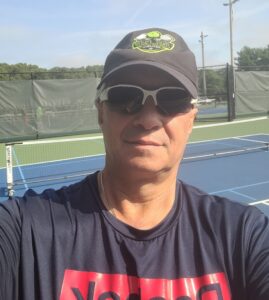
Introduction To Pickleball
I think pretty much everyone has heard of PICKLEBALL by now, a game reminiscent of tennis. It is the fastest growing sport in the USA, and now in other countries as well. It is tempting to just grab a paddle, go and play, but I would strongly recommend getting pickleball instructions and learning the game properly, even if you are a tennis player. I can tell you from my own experience that I have made this mistake before, and despite the seemingly easy transition to pickleball, because of my extensive background in tennis, I wish that I took some pickleball lessons and learn how to play it first, so I could avoid a lot of heartaches in my first pickleball tournament, because whether you are a beginner or advanced, you can learn from real good and experienced pickleball instructor how to control the ball better and how to play more efficiently for points in doubles or singles.
One of the best ways to learn to play pickleball quickly is from my pickleball teaching videos. The game of Pickleball offers more depth than initially meets the eye, for experienced players to master. I had to learn a lot in a hurry, which allowed me to win my first open pickleball tournament after only playing for 4 months. Now, after playing competitively and teaching for over 3 years – more than thousand students, I have developed a pretty good understanding of the game and how to teach it most effectively.
The purpose of this, hopefully comprehensive guide, will walk you through some of the learning basics of pickleball, mastering techniques and pickleball strategies with ab attempt to elevate your game.
Whether you’re stepping onto the court for the first time or looking to refine your skills, this guide provides the knowledge and insights you need to get started, to enjoy and excel at pickleball. Again nothing will replace a good pickleball instructor, preferably with a tennis background, so again, I urge you to check out my teaching videos!
Understanding the Pickleball Game: The Pickleball Court – Techniques/Strategies
Go to A Complete Guide to Pickleball Rules article to familiarize yourself with a pickleball rules first, then I would suggest to learn about the pickleball equipment used, which is extensively covered in A Complete Guide to Pickleball Equipment 2025
The Pickleball Court
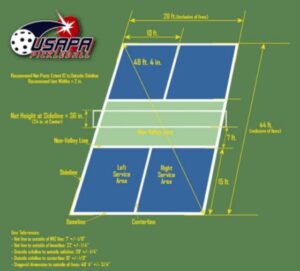
A pickleball court is much smaller in size than a tennis court, measuring only 20 feet wide by 44 feet long for both singles and doubles play. It is divided into several key areas:
- Baseline: The line at the back of the court.
- Sidelines: The lines running along the sides of the court.
- Non-Volley Zone (NVZ) or “Kitchen”: A 7-foot area on each side of the net where players are not allowed to volley the ball (hit it before it bounces). This rule is crucial for strategic play.
- Service Courts: The areas on either side of the centerline and outside the NVZ, where serves must land.
Pickleball Techniques and Strategies
This section delves into essential techniques and strategies to elevate your pickleball game, moving beyond the basic rules to more advanced play. It is not easy to read and learn how to play pickleball, this is why I have an extensive selection of pickleball teaching videos.
The main objective of this game is to get to the net, more specifically to the kitchen line, why? Because you will have a better control of the point rally from the net with your volleys, keeping your opponents at the baseline, and you will win more points from the net than from the back of the court.
-
Serve the Ball Deep and Strategically
-
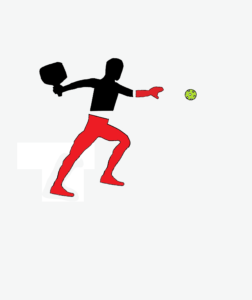
The pickleball serve is the only shot where you have complete control, because you decide where the ball will drop before you hit it, you don’t need to chase it or intercept it from the air, you control this shot from the beginning to the end. Aim for deep serves that land close to the baseline, pushing your opponents back and making their returns more difficult. Targeting your opponent’s weaker side, often their backhand, can also give you an advantage.
Of course this sounds easy, but in reality it is fairly difficult to do it consistently during a play, this is why using learning visually using teaching videos is invaluable!
Let’s examine pickleball serve step by step, which is demonstrated in great detail, as if through my teaching videos.
- To execute a pickleball serve You need to hit the ball from low to high, from below your waist, so the paddle motion has to be low to high.
- It’s best to stand sideways, because you have the most free range of motion. In most cases you will serve on the forehand side, basically hitting a forehand shot, and you can hit the ball from the air or let the ball drop to the ground first.
- The grip is very important. You should hold the paddle towards the end of the grip in a semi-western grip, which is in my opinion the best grip for forehand pickleball ground strokes, because you can take your paddle back with your wrist, which will create a delayed effect, resulting in more power. Combine this with a straight elbow at the moment of strike, and you will execute the most efficient and leveraged shot, as far as body mechanics are concerned. It is important to note that you keep your wrist back as long as possible and only while finishing the shot you will make a windshield wiper motion with your wrist, again watch the video on pickleball serve or pickleball forehand..
- In addition to the wrist back, you also want to take your arm back more so, then with regular forehand and execute the shot from low to high, covering the ball at the end with the windshield wiper move.
Of course the best way is to see it done that’s why nothing can replace the actual visual demonstration, so I strongly suggest, go through my teaching videos on pickleball serves.
-
Deep Strategic Placement of Serve Returns
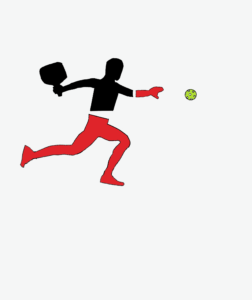
Similar to serves, deep forehand pickleball ball returns or backhand returns, close to the opponent’s baseline are crucial. A deep return forces your opponents to hit the ball from further back, making it more difficult to drive the ball or hit third shot drop, and at the same time, giving you and your partner more time to get to the Non-Volley Zone (NVZ-”kitchen”) line. Consider hitting returns to the opponent with a weaker third shot or to their backhand which is usually the weaker side.
- Hitting deep returns consistently is not easy at first. Most beginners and intermediate pickleball players try to hit the returns hard, which does not give them much time to get to the net, which should be your first objective.
- Remember, that your opponents are not at the net yet while you’re hitting returns, so you might try hitting your returns higher and harder, which will give the ball a longer flight, therefore allowing you more time to establish your position very close to the kitchen line (about 2 inches).
- To a certain degree, you can control from which side you would prefer to hit your returns, your forehand or a backhand side by choosing where you stand before you hit the return. If you leave most of the court open on your forehand side for example, your opponent will have no choice but serve to your forehand.
-
Move Your Feet and Bend Your Knees
Proper footwork on pickleball court and a low stance are fundamental. Moving your feet allows you to position yourself correctly to hit the ball out in front of you. Bending your knees helps you get low for groundstrokes and engages your leg muscles, improving shot execution and consistency.
- There is a world of difference in the way you move at the net versus at the baseline
- During pickleball dinking, for beginner players, it is important to utilize clock steps, see my teaching videos on dinking.
- Whether hitting backhand pickleball volleys or forehand pickleball volleys while playing doubles you use your outside feet to move left or right, while playing singles you might have to take two steps or a skip to the right or to the left.
-
Watch the Ball and Hit It in Front
Focus intently (keep an eye on the ball) on the ball as it approaches you, and adjust your position at the same time, so the ball will bounce in front of you and before you hit it, let it drop lower to your knee level. Hitting the ball out in front of your body with a low to high motion ensures better topspin technique, keeping you opponents at bay. With a paddle in front of you, compact movements allow you a quick reaction to a fast moving balls . Make sure to maintain a strong court position, very close to the “kitchen” line at the net and don’t back off, unless you or your partner hits the ball too high. Never back off straight backwards, as you might fall and hit a back of your head, but instead back off sideways or turn around and run back few steps if the time allows.
-
Be in “Pickleball Ready” Position
Always be in a ready position with your paddle up, and this includes how you hold your paddle (your grip). This is especially important at the net. You need to go back to a ready position after every volley and after every dink.
Pickleball Volleys
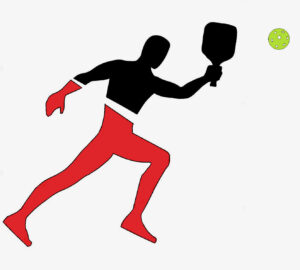
While at the net, before you hit the ball from the air, make sure you hold your paddle with a volley grip, which is different from the grip you would use from the baseline. Keep the paddle in front of you, face level, favoring slightly your backhand. Try to hit majority of volleys with your backhand volley, because it is easier to cover your whole body on that side. It is more difficult to hit forehand volleys if the ball travels at fast speeds towards you. For the right hander it would be 11 a clock position and for the left hander 1 a clock position. This allows for quick reactions to incoming shots and prepares you for your next move. During a doubles play (in singles play you need to make more than one step or skip to either side to reach the ball, as there is more space to cover), you should use the outside foot to move to the right or to the left to adjust your position to hit the pickleball volleys in front of your body for better control.
Pickleball Groundstrokes
In the game of pickleball, you want to transition to the net, the first chance you get, because you will be in better position to control the pickleball rally, hitting from the air (volleys) rather than groundstroke shots from the back of the court. However, hitting the ball from the baseline is unavoidable, whether it is a return or a 3rd shot, you will hold your paddle with a forehand or a backhand grips, which differ from each other, unless you use continental grip, which I don’t recommend, because you will end up hitting most of your shots flat without topspin. You should stand at least 3 feet behind the baseline on your returns, and adjust your position as soon as you know in which direction the ball is coming towards you.
Pickleball Forehand Groundstroke Drive
In my opinion, to hit the most efficient pickleball forehand groundstrokes, do following steps:
As you progress in your pickleball journey, you can adopt variations from the detail description below of the pickleball forehand groundstroke shot, which might include more open stance, but rotating your shoulders, more compact swing, etc.
The secret to successful forehand ground stroke that pretty much nobody will tell you is emphasized in the last step!
- hold your paddle with a Western grip
- straighten your arm down on your forehand side towards the ground
- take your wrist back (not your swing back)
- adjust your position sideways towards moving ball
- make first two steps towards the ball quicker then the rest, then slow down, adjust your feet and stop before making the shot
- keep the ball in front of you (not to the side of you), and let the ball drop to your knee level
- with your wrist still back, take your arm back, bend your knees, transition you body weight from the back foot to the front
- keeping your eyes on the ball, hit the ball with you elbow straight, from low to high motion, ending up across your opposite shoulder
- during this shot execution, keep your wrist back, creating delayed effect (whip effect), closing your wrist at the end of the shot in the windshield wiper motion
- while hitting the ball, turn your hips and your shoulders, straighten your knees, retaining your sideways position
- The harder you hit, the lower the shot has to be above the net (try to hit the white tape of the net) to avoid hitting outs
- The secret to successful pickleball forehand ground stroke is having a wrist back before you even take a first step towards the ball!
Pickleball Backhand Groundstroke Drive
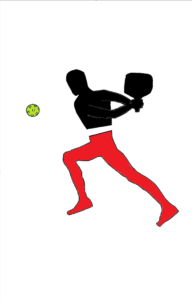
In my opinion, to hit the most efficient pickleball backhand groundstrokes, do following steps:
As you progress in your pickleball journey, again you can adopt some variations from the detail description below of the pickleball backhand groundstroke shot, but not as much as in forehand, such as slight more open stance, have fingers in the back of the paddle on both handed backhand, etc.
I will describe here both one and two handed backhand ground strokes.
Again, the secret to successful backhand ground stroke that pretty much nobody will tell you is emphasized in the last step!
- for one handed backhand, hold your paddle with a backhand grip (V-shape of your hand- between your thumb and you point finger is on the inner groove of your paddle), for two handed backhands, use continental (neutral( grip)
- for one handed backhand, straighten your elbow and pull your paddle back with the other hand
- for two handed backhand, straighten your arms down on your backhand side towards the ground
- adjust your position sideways towards moving ball
- make first two steps towards the ball quicker then the rest, then slow down, adjust your feet and stop before making the shot
- keep the ball in front of you (not to the side of you), and let the ball drop to your knee level
- make a step with you right leg (left leg for left handed) to the side pointing your toe diagonally
- for one handed backhand, with your arm already back, bend your knees, transition you body weight from the back foot to the front
- for one two handed backhand, take your arms back, keeping straight elbows, bend your knees, transition you body weight from the back foot to the front
- keeping your eyes on the ball, hit the ball with you elbow straight, from low to high motion, ending up across your opposite shoulder
- for one handed backhand, finish high across opposite shoulder for a cross court shot, but follow the ball with your paddle for the shot down the line
- for two handed backhand, hit the ball with your elbows straight, but bend them after the shot, finishing high across opposite shoulder
- while hitting the ball, turn your hips and your shoulders, straighten your knees, retaining your sideways position
- The harder you hit, the lower the shot has to be above the net (try to hit the white tape of the net) to avoid hitting outs
- The secret to successful one and two handed pickleball backhand ground stroke is having elbow(s) straight while hitting the ball!
-
Master the Pickleball Dink Shot
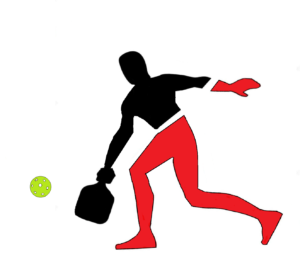
The pickleball dink is a soft shot hit from your NVZ (kitchen) that lands in your opponent’s kitchen, executing an unattackable shot, forcing them to hit the ball softly back to your kitchen, which is a typical play, however, you need to be in already position at all times, as you the opponent sometimes will hit a hard shot trying to tag you (I call it “smart Alec” play). Mastering the dink is essential for controlling the net, resets and creating offensive opportunities. To hit consistent dinks you need to have your paddle in front of you, preferably between your feet on the forehand side, pointing to the ground, and execute the shot without taking a swing, gently striking the ball up with a straight arm, ending up in the middle of your body. Ideally the ball should land in your opponents’ middle of the kitchen or at their feet, but away from their paddle, so they can’t accelerate the ball at you.
You are waiting for your opponent to strike the dink too far and too high, so you can accelerate the ball from the air at you opponents, ending the point in your favor. Practice cross-court pickleball dinking and straight-ahead dinks.
-
Pickleball Third Shot Drop and Drive
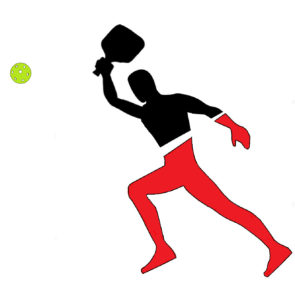
Pickleball Third Shot Drop is nothing more than a long dink from the baseline to the opponent’s kitchen, and it is a critical transitional shot in pickleball, because it allows you to run or at least get closer to the kitchen line, which is the main goal, because you are more in control of the point from the NVZ line. It is called a third shot, because it follows the return of serve. The goal of the third shot is to neutralize the point, because you are at a disadvantage in this stage of the game. So, the two common pickleball third shots are:
-
Third Shot Drop:
A soft shot hit from the baseline that lands in the opponent’s NVZ (kitchen), allowing you to advance to the net. If you can execute the shot consistently, it is a sign that you are becoming an advanced player. To hit a third shot drop consistently, have you paddle in front of you, and strike the ball low to high, so the ball reaches about six feet high above your “kitchen” line and then drops in the opponents’ kitchen.
-
Third Shot Drive:
A more aggressive shot hit with pace, low above the net, aiming to put pressure on the opponents at the net and potentially create a weak response. If your opponent’s return was weak and short or they don’t possess strong volleys, this is a sound strategy, but for more advanced players, this will not work in the long run, then I would hit a 3rd shot drop in most cases.
The bottom line is that you should decide based on your opponents abilities, and based on how weak your opponent’s return was, what type of 3rd shot to execute.
-
Control the Net (Non-Volley Zone)
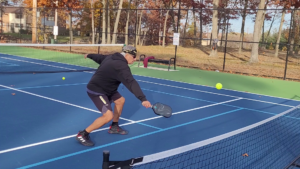
The Non-Volley Zone (NVZ), or “kitchen,” is a crucial area. Most pickleball points are won or lost at the NVZ line. Get to the NVZ line quickly after your third shot and maintain a strong, aggressive position. Avoid stepping into the NVZ unless the ball has bounced first.
-
Communication with Your Partner
In pickleball doubles, effective communication with your partner is paramount. Before the game begins, establish basic strategies, such as: who hits the middle shot from the baseline (usually forehand), from the kitchen (usually the person who is position first, not the person that just hit better turn), you can call out balls (e.g., “mine,” “yours,” “out”), but discuss strategy ahead of time, and provide encouragement during the game. This helps avoid confusion and ensures you cover the court effectively.
-
Pickleball – A Game of Patience and Consistency
Pickleball is often a game of patience and consistency. Avoid unforced errors by hitting consistent shots and waiting for the right opportunity to attack. Don’t go for winners on every shot; instead, focus on keeping the ball in play and forcing your opponents to make mistakes.
-
Shot Placement Over Power
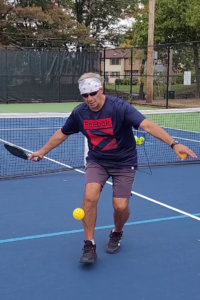
While power can be effective, shot placement is often more important in pickleball. Aim for open spaces on the court, target your opponents’ weaknesses, and use angles to your advantage. A well-placed soft shot can be more effective than a powerful but errant one.
-
Develop a Pickleball Pre-Serve Routine
A consistent pre-serve routine in pickleball can help with focus and consistency of your pickleball serve. This might include bouncing the ball a few times, taking a deep breath, and visualizing your serve. This routine helps to calm nerves and improve accuracy.
-
Anticipation and Court Awareness
Anticipate your opponents’ shots and be aware of their court positioning. This allows you to react more quickly and position yourself effectively for the next shot. Observe their tendencies and try to predict their moves.
-
Vary Your Shots
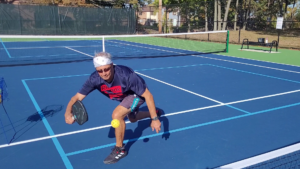
Don’t become predictable. Vary your shots in pickleball by mixing up pace, spin, and placement. Use a combination of dinks, drives, lobs, and volleys to keep your opponents off balance and guessing.
-
Practice Pickleball Drills
Regular practice of specific pickleball drills can significantly improve your skills. Focus on drills for serving, returning, dinking, third shot drops, and volleys. Consistent practice builds muscle memory and refines your technique.
Pickleball Conclusion
Pickleball is a dynamic and engaging sport that offers a fantastic blend of physical activity, strategy, and social interaction. By understanding the fundamental rules, mastering essential techniques like the dink and third shot, and employing smart
strategies, you can significantly improve your pickleball game and enjoy the sport to its fullest. Remember that consistency, patience, and effective communication with your partner are key to success. Regular practice, focusing on specific drills, will further refine your skills and elevate your performance on the court. Get out there, have fun, and enjoy the exciting world of pickleball!
